
Male Breast Cancer: Symptoms, Causes, Diagnosis, Treatment, and Outlook
Article Sidebar
Main Article Content
Male breast cancer is a rare cancer that develops in breast tissue in men. The most common sign is a painless lump near or behind the nipple. Other symptoms can include nipple discharge, nipple pulling inward, skin changes, or swelling under the arm. Risk increases with age and with inherited genetic changes, especially BRCA2 mutations. Diagnosis usually involves imaging and a biopsy. Treatment may include surgery, radiation therapy, hormone therapy, chemotherapy, and targeted medicines. Most male breast cancers respond to hormone treatment. Genetic testing is recommended for all men diagnosed with breast cancer because the results may affect treatment and relatives.
Cite as: Male Breast Cancer: Symptoms, Causes, Diagnosis, Treatment, and Outlook. Brisbane (AU): Exon Publications; 2024 Jul 07 [updated 2026 Sep 15].
Introduction
Breast cancer is much less common in men than in women, but men have breast tissue and can develop breast cancer. Male breast cancer accounts for less than 1% of breast cancers and is diagnosed most often in older men (1, 2). Because many people do not realize that men can develop the disease, symptoms may sometimes be ignored or mistaken for a harmless breast problem. Early assessment of a new breast lump or nipple change can help detect cancer before it spreads.
What Is Male Breast Cancer?
Male breast cancer develops when cells in the breast begin to grow in an uncontrolled way. Men normally have a small amount of breast tissue behind the nipple and areola. Cancer can develop from cells within this tissue.
The most common type is invasive ductal carcinoma, which begins in the ducts that normally carry milk in the female breast and then grows into surrounding tissue. Ductal carcinoma in situ, in which abnormal cells remain inside the ducts, can also occur.
Lobular breast cancer is much less common in men because male breast tissue normally contains few or no well-developed lobules.
Most male breast cancers have estrogen receptors, meaning the cancer cells can use the hormone estrogen to help them grow. This is important because hormone-blocking treatment can be very effective (1-3).
What Causes Male Breast Cancer?
Male breast cancer develops when genetic changes allow breast cells to grow and divide abnormally. In most cases, there is no single event that explains why these changes occurred.
Some genetic changes develop within breast cells during a person's lifetime. Others can be inherited from a parent.
Hormones also influence breast tissue. Conditions that increase estrogen exposure or alter the balance between estrogen and male hormones may increase the risk of breast cancer in men (1, 3).
Having a risk factor does not mean that a man will develop breast cancer. Many men who develop the disease have no obvious cause.
Who Is at Risk of Male Breast Cancer?
Risk increases with age. Most men are diagnosed later in life, although breast cancer can occur in younger men (1).
Important risk factors include:
Inherited genetic changes: BRCA2 is the best-established inherited risk factor for male breast cancer. BRCA1 and changes in other genes, including PALB2 and CHEK2, can also increase risk (2, 4).
Family history: Having close relatives with breast cancer, ovarian cancer, pancreatic cancer, prostate cancer, or male breast cancer may suggest an inherited cancer predisposition.
Klinefelter syndrome: Men with Klinefelter syndrome have an extra X chromosome and have a substantially higher risk of breast cancer than other men.
Radiation exposure: Previous radiation treatment to the chest can increase breast cancer risk later in life.
Hormonal conditions: Conditions associated with increased estrogen levels or reduced androgen levels can raise risk.
Obesity: Body fat can increase conversion of hormones into estrogen and has been associated with greater male breast cancer risk.
Liver disease: Severe liver disease can disturb normal hormone balance and may increase estrogen levels.
Risk factors help identify people who may need closer assessment, but they cannot predict with certainty who will develop cancer.
Why Are BRCA Gene Mutations Important?
BRCA1 and BRCA2 are genes involved in repairing damaged DNA. A harmful inherited change in one of these genes can make it easier for cancer-causing genetic damage to accumulate.
BRCA2 mutations are particularly important in male breast cancer. Men who inherit a harmful BRCA2 change have a much higher lifetime risk of breast cancer than men in the general population. BRCA mutations can also increase the risk of other cancers, including prostate and pancreatic cancer (2, 4).
Current guidance recommends that all men diagnosed with breast cancer be offered genetic counseling and germline genetic testing, rather than limiting testing only to men with a strong family history (2).
Finding an inherited mutation can affect treatment decisions and future cancer surveillance. It can also provide important information for biological relatives because children, siblings, and other family members may carry the same genetic change.
What Are the Symptoms of Male Breast Cancer?
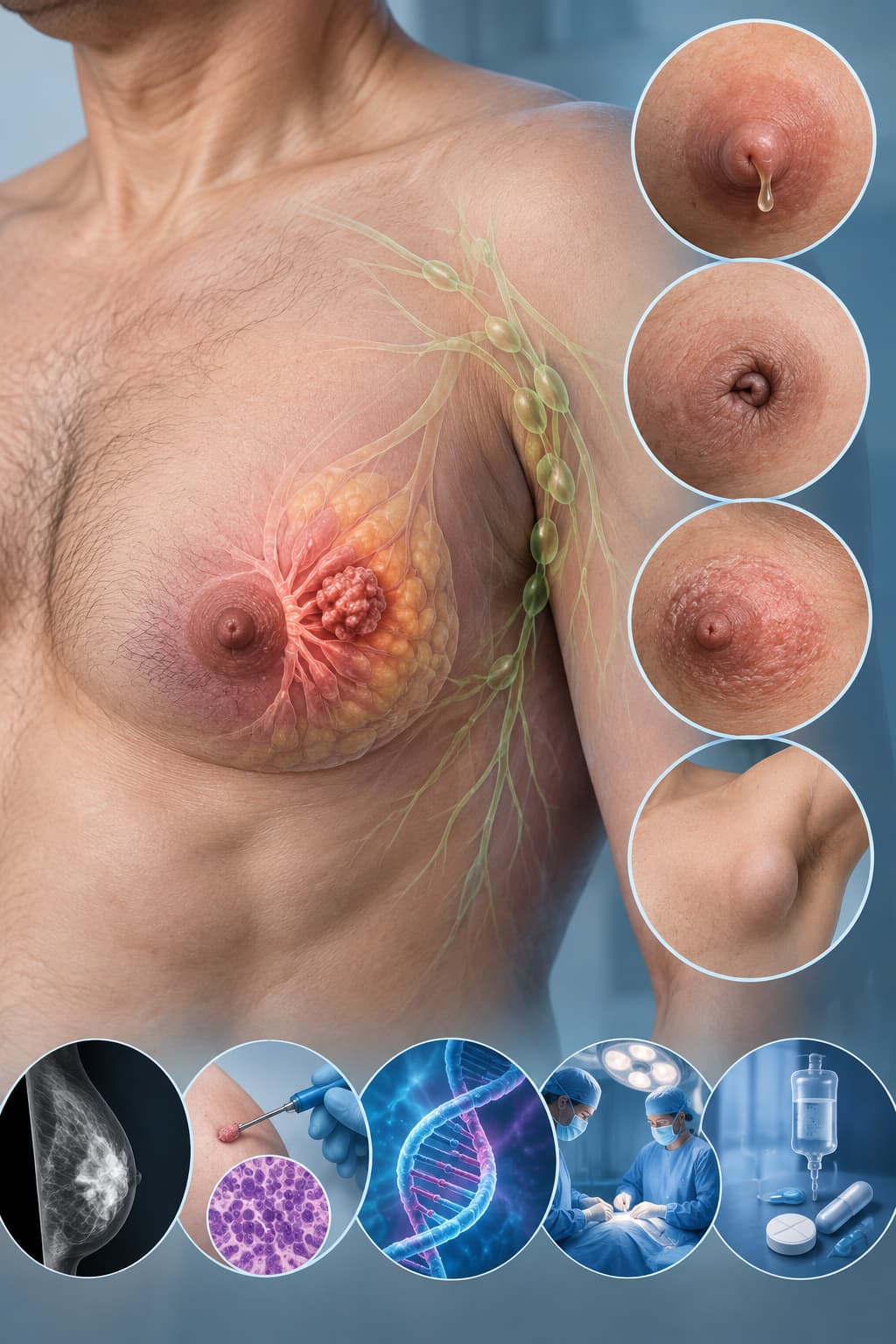
The most common symptom is a new lump in the breast, often close to or directly behind the nipple. The lump is frequently painless and firm.
Other possible symptoms include:
- nipple pulling inward
- nipple discharge, which may sometimes contain blood
- redness, scaling, ulceration, or other changes of the nipple
- dimpling or puckering of the breast skin
- swelling or thickening of part of the breast
- a lump or swelling in the armpit
- changes in the shape or position of the nipple
Because men have relatively little breast tissue, a tumor can be close to the nipple, skin, or chest wall even when it is not very large.
Breast pain alone is less commonly a sign of cancer, but any persistent or unexplained breast change should be assessed.
Is a Male Breast Lump Always Cancer?
No. Most breast enlargement or breast lumps in men are not caused by cancer.
A common noncancerous condition is gynecomastia, which is an increase in male breast tissue caused by hormonal changes. It can occur during puberty, with aging, as a result of certain medicines, or because of medical conditions that affect hormone levels.
Gynecomastia often causes a rubbery or tender area of tissue directly beneath the nipple and may affect both breasts, although one side can be larger.
Breast cancer is more likely to cause a firm, irregular, usually painless lump. Nipple discharge, skin ulceration, nipple retraction, or enlarged lymph nodes may also raise concern.
These differences are useful clues but cannot reliably distinguish cancer from a benign condition. A persistent or suspicious breast lump requires medical assessment and, when appropriate, imaging and biopsy (1, 3).
How Is Male Breast Cancer Diagnosed?
Diagnosis usually begins with a clinical examination of the breast, nipples, chest wall, and lymph nodes.
Mammography: Mammography uses low-dose X-rays to examine breast tissue. It can help distinguish suspicious masses from conditions such as gynecomastia.
Ultrasound: Ultrasound uses sound waves to examine a lump and can help assess the breast and nearby lymph nodes.
Biopsy: A biopsy is needed to confirm breast cancer. A needle is used to remove a sample of tissue, which is examined under a microscope.
The pathology report identifies the type of cancer and other features that influence treatment.
Cancer cells are routinely tested for estrogen receptors (ER), progesterone receptors (PR), and human epidermal growth factor receptor 2 (HER2). These markers help determine which medicines are likely to work (1-3).
Genetic testing of the cancer itself may also be useful in some situations, particularly when disease has spread or targeted treatment is being considered.
How Is Male Breast Cancer Staged?
Staging describes how much cancer is present and whether it has spread.
Doctors assess the size of the breast tumor, whether nearby lymph nodes contain cancer, and whether the cancer has spread to distant organs.
Early-stage breast cancer is limited to the breast or nearby lymph nodes. Metastatic breast cancer has spread to distant parts of the body, such as the bones, liver, lungs, or other organs.
Imaging tests used for staging depend on the stage suspected from the initial examination, biopsy, and other findings. People with small early cancers may not need extensive body scans.
The stage is important because it helps determine treatment and provides information about outlook.
How Is Male Breast Cancer Treated?
Treatment depends on the stage and biological features of the cancer as well as the person's age, general health, inherited genetic findings, and preferences.
Because male breast cancer is uncommon, relatively few large treatment trials have included men. Many recommendations are therefore based partly on strong evidence from breast cancer in women combined with studies specifically involving men (2, 3).
Treatment may include surgery, radiation therapy, hormone therapy, chemotherapy, HER2-directed therapy, and other targeted medicines.
What Surgery Is Used for Male Breast Cancer?
Surgery is a major treatment for most early male breast cancers.
Mastectomy: Many men undergo removal of the breast because there is only a small amount of breast tissue and tumors are often close to the nipple.
Breast-conserving surgery: Removal of the cancer while leaving some breast tissue may also be possible in selected men. Breast-conserving surgery is usually followed by radiation therapy.
The lymph nodes under the arm are also assessed when appropriate. A sentinel lymph node biopsy can identify the first lymph nodes that drain the breast. If these nodes do not contain cancer, more extensive lymph node surgery may often be avoided.
The surgical approach should be based on the cancer rather than on the assumption that every man requires mastectomy (1, 3, 5).
When Is Radiation Therapy Used?
Radiation therapy uses high-energy radiation to destroy cancer cells in a specific area.
It is normally recommended after breast-conserving surgery to reduce the chance of cancer returning in the breast.
Radiation may also be recommended after mastectomy when the risk of local recurrence is higher, such as when the tumor is large, cancer involves several lymph nodes, or other high-risk features are present.
For metastatic disease, radiation can also be used to reduce pain or treat cancer in particular sites, such as bone.
How Is Hormone-Positive Male Breast Cancer Treated?
Most male breast cancers contain estrogen receptors and can respond to endocrine, or hormone-blocking, treatment.
Tamoxifen is the preferred endocrine treatment for most men with hormone receptor-positive early breast cancer. Tamoxifen blocks the effect of estrogen on breast cancer cells.
ASCO recommends an initial five years of tamoxifen for men who need adjuvant endocrine therapy. Men who remain at substantial risk of recurrence and tolerate treatment may sometimes continue for up to ten years (2).
Tamoxifen can cause side effects, including hot flashes, sexual problems, mood changes, weight changes, and an increased risk of blood clots. Side effects vary considerably between individuals.
If tamoxifen cannot be used, an aromatase inhibitor may sometimes be combined with treatment that suppresses testicular hormone production. An aromatase inhibitor alone is generally less suitable for men because the testes continue to produce hormones that can be converted to estrogen (2).
When Are Chemotherapy and Targeted Treatments Used?
Chemotherapy may be recommended when the cancer has features associated with a higher risk of recurrence. These can include larger tumors, lymph node involvement, certain aggressive tumor types, or cancers without hormone receptors.
HER2-positive male breast cancer can be treated with HER2-directed medicines according to the same biological principles used for HER2-positive breast cancer in women (2, 3).
Other targeted treatments are increasingly important in advanced breast cancer. Depending on the cancer's hormone receptors, HER2 status, genetic mutations, and previous treatments, options may include CDK4/6 inhibitors, PARP inhibitors, antibody-drug conjugates, and other targeted medicines.
PARP inhibitors can be particularly relevant to some people with inherited BRCA1 or BRCA2 mutations.
These treatments are not needed for every man with breast cancer. Their use depends on the exact biological characteristics and stage of the cancer (3).
How Is Metastatic Male Breast Cancer Treated?
Metastatic breast cancer has spread beyond the breast and nearby lymph nodes to distant parts of the body.
Treatment aims to control the cancer, reduce symptoms, maintain quality of life, and extend survival.
For hormone receptor-positive metastatic disease, endocrine therapy is usually preferred before chemotherapy unless the disease is causing rapidly worsening organ problems (2).
Modern endocrine treatment may be combined with targeted medicines such as CDK4/6 inhibitors. HER2-positive disease can receive HER2-directed therapy. People with certain inherited BRCA mutations may be eligible for PARP inhibitors.
Chemotherapy and other medicines remain important when cancer does not respond to hormone treatment or when the tumor's biology makes chemotherapy more appropriate.
Treatment is adjusted over time according to how the cancer responds and which side effects occur.
What Happens After Treatment?
Follow-up after treatment focuses on detecting recurrence, managing side effects, and maintaining general health.
Men who have undergone breast-conserving surgery should generally be offered annual mammography of the treated breast when technically possible (2).
Men with an inherited mutation that increases breast cancer risk may also be offered mammography of the opposite breast. Routine breast magnetic resonance imaging is not recommended for most men after treatment (2).
Men who have had a mastectomy generally do not need routine mammography of the removed breast. New lumps, skin changes, chest-wall changes, or other concerning symptoms should still be assessed.
Long-term care may also include management of treatment effects such as reduced shoulder movement, arm swelling caused by lymphedema, hot flashes, sexual changes, fatigue, and emotional effects.
Can Male Breast Cancer Come Back?
Male breast cancer can return after treatment, as breast cancer can in women.
A local recurrence occurs in the remaining breast tissue or chest wall. A regional recurrence involves nearby lymph nodes. A distant recurrence, or metastatic recurrence, occurs when cancer appears in organs elsewhere in the body.
The risk of recurrence depends on the original stage, lymph node involvement, tumor biology, hormone receptor status, genetic features, and treatments received.
Hormone receptor-positive breast cancer can sometimes recur many years after the original diagnosis. This is one reason endocrine treatment and long-term follow-up are important.
What Is the Outlook for Men With Breast Cancer?
The outlook varies widely. It depends mainly on the stage at diagnosis, tumor biology, age, general health, and response to treatment.
Men are sometimes diagnosed at a later stage than women, partly because breast cancer is less expected in men and a lump may not be investigated immediately (1, 3). Earlier diagnosis generally provides more treatment options and a better chance of long-term disease control.
Many men with early-stage breast cancer can be treated successfully. Advanced breast cancer is generally not considered curable, but modern endocrine treatments, targeted medicines, chemotherapy, and supportive care can control disease for meaningful periods in many people.
Population survival statistics describe groups and cannot predict the outcome for an individual person.
Conclusion
Male breast cancer is uncommon, but any man can develop it. A painless lump near the nipple is the most common warning sign, although nipple discharge, skin changes, nipple retraction, and enlarged lymph nodes can also occur. Diagnosis requires imaging and biopsy, followed by testing of hormone receptors, HER2, and other tumor features. Treatment may include surgery, radiation therapy, hormone therapy, chemotherapy, and targeted medicines. Most male breast cancers are hormone receptor-positive, making tamoxifen an important treatment. All men diagnosed with breast cancer should be offered genetic counseling and inherited genetic testing. Early assessment and treatment matched to the cancer's individual features offer the best chance of good long-term control.
References
- Bhardwaj PV, Gupta S, Elyash A, Teplinsky E. Male breast cancer: a review on diagnosis, treatment, and survivorship. Curr Oncol Rep. 2024;26(1):34-45. https://doi.org/10.1007/s11912-023-01489-z
- Hassett MJ, Somerfield MR, Baker ER, et al. Management of male breast cancer: ASCO guideline. J Clin Oncol. 2020;38(16):1849-1863. https://doi.org/10.1200/JCO.19.03120
- Ter-Zakarian A, Agelidis A, Jaloudi M. Male breast cancer: evaluating the current landscape of diagnosis and treatment. Breast Cancer (Dove Med Press). 2025;17:567-572. https://doi.org/10.2147/BCTT.S516124
- Fanale D, Corsini LR, Brando C, et al. BRCA-associated hereditary male cancers: can gender affect the prevalence and spectrum of germline pathogenic variants? Front Oncol. 2024;14:1414343. https://doi.org/10.3389/fonc.2024.1414343
- Lissidini G, Nicosia L, Sargenti M, et al. Male breast cancer: a multicenter study to provide a guide for proper management. Breast Cancer Res Treat. 2024;208(1):29-40. https://doi.org/10.1007/s10549-024-07380-0
- Li Y, Huang Y, Huang H, et al. Global, regional, and national burden of male breast cancer in 204 countries and territories: a systematic analysis from the Global Burden of Disease Study, 1990-2021. eClinicalMedicine. 2025;80:103027. https://doi.org/10.1016/j.eclinm.2024.103027
This article is part of the 'Public Education Series' initiative by Exon Publications.
Disclaimer: This article is for general educational purposes only and does not constitute medical advice, diagnosis, or treatment. Consult a qualified healthcare professional about personal health concerns.
Note on External Links: External links were checked and accessible when this article was published. Their content and availability may change over time and are outside the control of Exon Publications.
Downloads
Article Details

This work is licensed under a Creative Commons Attribution-NonCommercial-NoDerivatives 4.0 International License.